

A few days ago Terrible Gamers published an updated review of the free to download Tunnels & Trolls 5th Edition rules. Our updated review was based on our extensive play test of Tunnels & Trolls as a GM led role playing game. We also let our readers know that, because one single person was kind enough to donate money to Terrible Gamers, we were able to purchase a copy of the most up-to-date version of the Tunnels & Trolls rule set–v7.5 (available for $15 from DriveThruRpg). After downloading and quickly reading through the Tunnels & Trolls v7.5 rules Terrible Gamers decided to update our original review once again.
The reasons for this decision are pretty straight forward. Even during our first review of Tunnels & Trolls we made it clear that we prefer to do reviews of games based on the latest available rules. Having our reviews reflect current published game mechanics is most useful to our readers, and provides the fairest possible accounting of any game system. Indeed, in most situations we would not have bothered with a review that solely looked at a game’s outdated rules. We made an exception in the case of Tunnels & Trolls because Flying Buffalo, the game’s publisher, has released the Tunnels & Trolls 5e rules to the public. And as we said in our other reviews, Flying Buffalo’s reasoning–5th Edition is a legitimate fee alternative to the v7.5 rules for those who are new to Tunnels & Trolls–was quite sound.
Because of this an updated review of Tunnels & Trolls v7.5 was a foregone conclusion; however, it only took Terrible Gamers a few minutes to realize that we needed a quick turn around on that update. As it turns out Tunnels & Trolls v7.5 addresses most of the concerns we noted in our original review. We encourage our readers to go back and read the original review (here) and the updated review (here), particularly if they find themselves wanting insight into our original grades.
Updated Review:
What you need:
- Tunnels & Trolls v7.5
- Pencil or Pen (we prefer pencil)
- Paper and/or Graph Paper
- At least 1 six sided die (D6). We used 8 of gamescience’s D6s (the best dice in the world)
Optional:
- Smartphone or Calculator (less important if you are playing the game with a GM)
- Homemade Dice Rolling Box (you can use the table just as well)

Character Creation/Attributes: 5th Edition
Original Scores: C+
 The Tunnels & Trolls v7.5 character generation process is just as easy and straightforward as it was in Tunnels & Trolls 5th Edition. If you recall, Terrible Gamers felt that the 5th Edition method of generating primary attribute scores had a decidedly “old school” feel. In the older version of the game, you simply roll 3 six sided dice (3D6) for each of the character’s 7 attributes–Strength (ST), Intelligence (IQ), Luck (LK), Constitution (CON), Dexterity (DEX), Charisma (CHR), and Speed (SPD). These attributes represent the basis of a character’s talents and abilities.
Terrible Gamers had mixed feelings about generating attributes this way. Since the Tunnels & Trolls 5th Edition rules only allow one 3D6 roll for each attribute score, the result is often pretty skewed characters that can quickly brutalize the players, particularly when the players are using Tunnels & Trolls Solo Adventures. Our original scoring of the Tunnels & Trolls 5th Edition character generation (C+) was largely based on this.
Terrible Gamers felt that players who were more comfortable with modern role playing game systems, like Dungeons & Dragons 4e, expect character generation systems to result in characters that were more even and balanced than what we were seeing with Tunnels & Trolls 5th Edition; however, we also recognized that the Tunnels & Trolls 5th Edition character generation system had some distinct advantages, like speed and character diversity, which we highlighted in our first updated review of the game.
Character Creation/Attributes: v7.5
New Score: A-

Tunnels & Trolls v7.5 Character Sheet
The character generation process of Tunnels & Trolls v7.5 is a marked “improvement”–there is value in the original system–over Tunnels & Trolls 5th Edition. Specifically attribute generation has been modified in v7.5 to be much more in-line with other more “modern” role playing game rule sets. For example, v7.5 offers players and GMs three ways to generate characters, which completely replace the rules found in T&T 5e.
The first method suggested in the v7.5 rules is a modification of the original attribute “roll” system. Instead of having a player roll 3D6 per attribute, as with T&T 5e rules, v7.5 has characters roll 4D6, players keeping the highest 3 dice rolls. This method ensures that players are much more likely to have balanced characters attributes. This makes it nearly impossible to see the characters with multiple attribute scores below 9 that Terrible Gamers routinely encountered when play testing T&T 5e.
Example: Ginell is generating a character for Tunnels & Trolls v7.5. To get her attribute score for Strength she rolls 4 six sided dice whose scores are 6, 3, 3, and 1. She then keeps the highest 3 scores and adds them together, leaving her with a Strength of 12.
The second method of rolling for attribute using v7.5 rules is nearly identical to the types of rules a player would find in modern fantasy role playing games like Dungeons & Dragons. Like the first method, the players’ 2nd option generates attribute scores by rolling of 4D6 and keeping the three highest scores. What distinguishes the second method from the first is that the 2nd option allows players to “bank” the attribute scores and then assign those scores to whichever character attribute the player chooses. This allows the players substantially more control over shaping their character. A player can decide where there character will be the strongest using this method, which gives them greater freedom to pick their character class.
Example: Steve is generating a character for Tunnels & Trolls v7.5 using the second character generation method. Like Ginell, Steve will roll 4D6 once for each attribute, keeping the score of the highest 3 dice. Instead of immediately assigning those scores to an attribute, Steve banks them by writing them down on a sheet of paper. Steve scores are 16, 16, 13, 11, 10, and 8. Steve then has the opportunity to chose which score he wants to assign to each individual attribute.
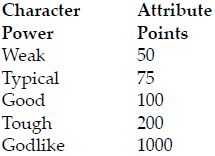
T&T v7.5 provides a convenient chart to help players determine how many points to use
Finally Tunnels & Trolls v7.5 gives players and GMs a “point buy” option for character generation. This too is very similar to a number of modern games. Essentially the GM, or player if she is running a Solo Adventure, decides that each player gets a set number “points” to generate their character attributes (T&T v7.5 provides a convenient chart to help players determine how many points to use). Each point is then assigned to an attribute on a 1 for 1 basis. Even more so than the second method, the point buy system ensures that characters will have evenly powered and balanced characters. It also allows players to have total control over class choice and character disposition.
Example: Scott is generating a T&T v7.5 character using the point buy method. His GM has given him 100 points to work with. Scott decides that he wants to make a magic user. Therefore Scott, assigning his points on a 1 on 1 basis, decides that his character attributes will be as follows: STR 10, CON 10, DEX, 14, SPD 10, INT 18, WIZ 16, LK 14, CHR 8 (for a total of 100).
Races, Starting Wealth, Character Classes/v7.5
If you remember our original review of T&T 5th Edition then you know that character wealth in T&T 5e is generated by a die roll (3D6 x10). The wealth generation system for starting characters in Tunnels & Trolls v7.5 is exactly the same. In both cases Terrible Gamers feels that starting characters off with wealth based on random chance, particularly when the costs of starting equipment is so high, detracts from the game. Certainly, we understand that getting new equipment for characters is one of the things that role playing game players look forward to as their characters advance, but when a character with a starting wealth of 40 gold pieces (g.p.) cannot afford a weapon we think this detracts from player enjoyment .
Rule of Three: An interesting mechanic was added to Tunnels & Trolls v7.5 that reduces the likely hood that a character will end up with the lowest possible attribute score or starting wealth. Indeed, it also greatly increases the likelihood of higher scores for starting characters all around! Essentially, every time natural triples are rolled (1,1,1 or 2, 2, 2, or 3,3,3, or 4, 4, 4, or 5, 5, 5, or 6, 6, 6) a player can roll the dice again, adding her original score to the total of the new roll. She repeat this, potentially infinitely, until she no longer roll natural triples.
Example: if Ginell is rolling for her starting wealth (3D6 x 10) and her first roll is triple 1s (1, 1, 1) and her second roll is 2, 3, 3 she takes her original total (3), adds that to her second total (8), then multiplies the sum (11) by ten to arrive at her starting wealth (110 g.p.).
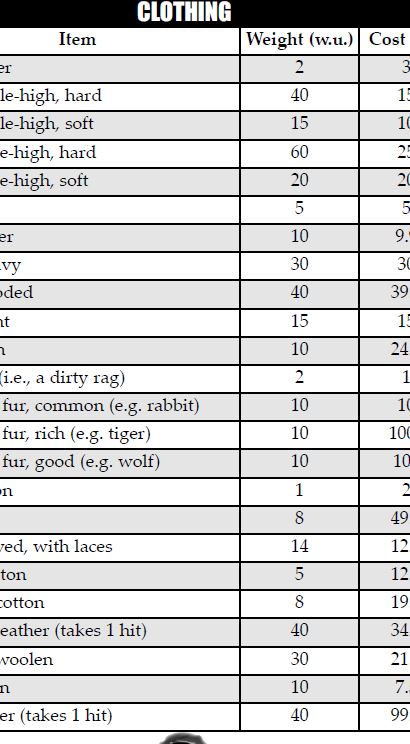 One nice thing about Tunnels & Trolls v7.5 is the equipment list. It is significantly more comprehensive than the one Flying Buffalo made available for T&T 5th Edition. While this does slightly increase the time the character creation process takes–there was more things for us to chose from for our characters–the overall benefit to the game far outweighs any negative from the few minutes extra it takes to make characters.
We also liked the expansion of character classes in v7.5. While T&T 5th Edition alluded to 4 character classes, only two–the warrior and the wizard–are actually available with the free download. v7.5 offers 6 different character classes to choose from; that is if a character’s attributes meets the character class’s minimum stat requirement.
- Citizen: This character class is supposed to represent your average person in Trollworld (the Tunnels & Trolls campaign setting). While the Citizen is mostly reserved for GM’s to populate their worlds, players looking for a challenge can play this class.
- Rogue: Not your typical fantasy role playing game “thief.” “Rogue” stands for Rogue wizard, someone who uses magic and is not part of the Wizard’s Guild. They are not quite as adept at magic as the Wizard.
- Warrior: Your typical role playing fighter class. A Warrior gets bonuses to his combat abilities.
- Wizard: Men and Women trained by the Wizard’s Guild to use magic. Wizards are the default magic using character class.
- Specialist: This is a catch all character class used to make characters that might resemble character classes from other games. Think longbow wielding Elven ranger.
- Paragon: A very rare character class whose minimum attribute requirements make it very difficult to attain. Paragons are a mixture between Warriors and Wizards.

Peters-MacAllistor Chart
Once a player has determined his character’s attribute scores, starting wealth, and character class he is free to choose a “race” for his character. Race (renamed “Kindred”) in v7.5 works much like it did in Tunnels & Trolls 5e. Instead of the attribute modification you might find in a game like Dungeons & Dragons 4e, Tunnels & Trolls makes use of what it class the Peters-MacAllistor Chart. Essentially, Tunnels & Trolls requires players to pick a character race from a chart, then multiply their current attribute score by the racial modifier listed for each attribute.
In T&T 5th Edition this meant that a player sometimes had to multiply their attribute score by a fraction. While v7.5 retains racial modifiers that are not whole numbers, Terrible Gamers is happy to report that these are now listed as decimals. This makes these calculations much more calculator friendly for players like us who need to think for awhile about the proper procedure for doing multiplication with fractions.
Having to do mathematics like this at all was something that Terrible Gamers was divided on (pun intended). On the one hand we think that Tunnels & Trolls would be a great game to help teach simple arithmetic to children. The fact that Tunnels & Trolls is really the only tabletop role playing game that provides strong support to Solo Adventures (see the original review to learn more) helps it’s case in this regard; however, for adult gamers the extra math tends to add unneeded complexity to character creation, and actually works against one of Tunnels & Trolls‘ chief advantages over other games–speed. If the Flying Buffalo’s intended audience is the latter, it would be better if they could derive (another pun) a racial system for characters that works by adding and subtracting a static set of whole numbers.
Game Mechanics & Combat/T&T 5th Edition & v7.5
Original Score: B-
New Score: B
One of Terrible Gamers favorite parts about both Tunnels & Trolls rule sets are the skill challenge mechanics. Unlike most other table top role playing games, there are no real “skills” sy in either T&T 5th Edition or v7.5. Instead players are asked to make saving throws of varied difficulties against one of their attribute scores. For instance, a character who is trying to run away from a pack of goblins might be asked to perform a series of saving throws against her Speed. Another character who trying to explain to the local noble why exactly he had absconded with the noble’s daughter might be asked to make a saving throw against his Charisma.
The only significant difference that we found between Tunnels & Trolls 5th Edition and Tunnels & Trolls v7.5 when it came to how skill checks were handled was v7.5′s addition of “talents.” These are attached to attributes and represent things that a character is particularly skilled at. Talents add a bit of depth to skill mechanics and help flesh out characters in interesting ways without harming the original mechanics simplicity.
We will not go into great detail about the mechanics themselves (check on the other two reviews). What we will say is that Terrible Gamers really appreciated how intuitive these mechanics were for both the players and the GM. This, above all else, said to us that Ken St. Andre and company at Flying Buffalo really accomplished what they set out to do. They have made a game whose core mechanics are easy to grasp–even for those with little to no role playing experience.
Combat is similarly simple and easy to learn. It requires players to roll a number of D6s equal to that players total “weapons” dice. The total number is then added to a charater’s total personal and weapon bonuses (called “adds”). The player’s new total number is then compared to what the GM has rolled (using the same process) for the opponent. The side with the highest roll has scored a “hit,” and damage is calculated by finding the difference between the two scores. Any damage dealt is then mitigated by armor (similar to Warhammer Fantasy Roleplay) and subtracted directly from that characters Constitution score. There are no hit points or wound levels in Tunnels & Trolls. A character’s Constitution score, or a monsters Monster Rating (MR), act as the sole representation of a character’s health.
Example: Steve’s character is involved in a bar fight. Steve decides that he is going to use his short sword to attack his opponent. The short sword has a “dice rating” of 3 and an “add” bonus of 2. Steve has a personal “add” bonus of 12. So Steve rolls his weapon’s dice rating (3D6) scoring a 6, 5, and a 3. Steve then adds his dice total (14) to the his total weapon and personal “adds” (14) giving him a score of 28. The GM rolling for Steve’s opponent got a score of 20. Steve and the GM’s “to hit” numbers are compared. Because Steve’s 28 is higher than the GM’s 20, Steve wins. This means that Steve has hit his opponent and deals 8 points of damage. That 8 points is subtracted from the armor level of Steve’s opponent, which is 2, leaving 6 damage. The GM then subtracts 6 points from the bartough’s Constitution score. In this case the bartough’s Constitution score drops from 10 to 4. 4 more points of damage will knock the barthough out of the fight.
While the combat system, like the rest of v7.5, is quick and easy to learn, the system has significant drawbacks. While playing Solo Adventures it is not uncommon for a player to find that she is in a combat encounter where her character will die before a single die is rolled. For example, when Terrible Gamers was play testing the Tunnels & Trolls Solo Adventure Goblin Lake (free when you download T&T 5th Edition) we found ourselves in a combat where our plucky goblin character, who had a maximum total “to hit” of around 23, was facing down a monster whose minimum “to hit” score was over 50. Since our goblin had a Constitution of 7 we knew our character was dead as soon as we read the stats.
Similarly Tunnels & Trolls handles grouped combat by having the player(s) or GM calculate an entire groups “to hit” score as if that group were a single creature. When running Solo adventures this means that groups of creatures a character might be able to handle easily on a 1v1 basis become quite deadly. So deadly in some cases that, as in our Goblin Lake example, a character is dead without needing to roll a single die.
This problem, in both versions of Tunnels & Trolls, is mitigated somewhat in games that are run by GMs. Players are aided in this context by two factors. First the player group rolls their “to hit” scores as a single entity. Second, if the players lose to the monsters they are fighting, Tunnels & Trolls allows the damage dealt to the group to be distributed as players see fit. In this way, Warriors with higher constitution scores than their more fragile companions can soak up more of the damage.
Terrible Gamers thinks that while the original issue–having characters who are literally killed before dice are rolled–is mitigated by group play, Tunnels & Trolls combat is not for everyone. One of the effects of having players combine all of their combat actions together is that Tunnels & Trolls’ combat does not deliver a very tactical feel. More than that, there is a pronounced lack in Tunnels & Trolls of the sense that players’ characters are contributing individually to combat, which can harm player enjoyment. We like those moments in games when a thief sneaks up behind a monster and takes it out unawares or when the fighter scores a critical success and cleaves his opponent in two. Tunnels & Trolls 5th Edition and Tunnels & Trolls v7.5 just don’t have that.
Finally our original opinion of the ranged combat system present in Tunnels & Trolls 5th Edition stands. The ranged system utilizes the saving throw mechanic we discussed early to determine whether or not a character hits her target. This system advantages those shooting at opponents from afar by making it impossible for the target of a ranged attack to “fight back.” We love it! This makes Tunnels & Trolls’ ranged combat more realistic than what you might find in a different game. It really isn’t a good idea to go for your sword when 10 crossbows are pointed at you!
Magic System: T&T 5th Edition & v7.5
Old Score: N/A
New Score: A-
The magic systems in T&T 5th Edition and v7.5, like their combat systems, are nearly identical. In both games magic casting is done through the use of a “spell point” system where players have access to a list of spells that their characters can “cast” with the expenditure of “magic points.” In T&T 5th Edition these magic points consisted of a characters Strength attribute score. When a character casts a spell, she temporarily reduces her Strength score by that spells casting cost. Terrible Gamers really liked this. Besides having a slight preference for “magic point” systems over “spells per day” systems (Dungeons & Dragons 4e), we really liked the idea that a Wizard casting magic was slowly reducing her strength.
We were slightly disappointed that Flying Buffalo has altered this mechanic in Tunnels & Trolls v7.5. The newer version uses a new attribute–Wizardry–instead of Strength as the source of a characters “magic points.” Despite our disappointment, the Wizardry attribute does work better mechanically in that it is also used to determine a Wizard’s magical strength and the difficulty of spells cast on specific characters. So Terrible Gamers certainly did not hold this change against Tunnels & Trolls v7.5.
 Finally we cannot leave the magic portion of this review without commenting the names of spells in Tunnels & Trolls. There is a level of comedic irreverence built in to the magic system that Terrible Gamers appreciates very, very, very much! You cannot lose with a magic system that contains a set of spells like: “Take That You Fiend!,” “Oh-Go-Away,” “Little Feets,” “Whammy,” and “Slush Yuck!
Character Advancement: v7.5
Original Score: B
New Score: A
In Tunnels & Trolls v7.5 the odd, yet workable, character advancement scheme of T&T 5th Edition was done away with completely. Instead of allowing characters to increase certain sets of attributes by numbers arrived at by modifying a character’s newest level, v7.5 uses a pretty simple experience point “buy.” Players can now raise their attribute scores whenever they like by spending their accumulated experience. To determine how much experience (adventure points) raising an attribute by 1 costs, you multiply an attributes current score by 10.
Example: Ginell has 400 adventure points to spend on increasing her Tunnels & Trolls v7.5 character’s attributes. Ginell wants to raise her character’s Constitution score–her lowest at 8. To calculate how much of her adventure points it will cost to raise her characters Constitution score from 8 to 9, Ginell multiplies the current score (8) by 10. Ginell spends the 80 adventure point cost–raising her character’s constitution score to 9– leaving her character with 320 adventure points.
Conclusion & Final Score:
Original Score: B-
New Score: A-
Overall Value: A
There are a couple things readers should keep in mind when reading our updated review of Tunnels & Trolls v7.5. First, while our review does cover the most current and up-to-date version of Tunnels & Trolls, our review’s publication comes about one month before Flying Buffalo’s Rick Loomis and Steven Crompton (you can see part of our interview with Steven here) have told Terrible Gamers that the newest version of Tunnels & Trolls will be released–the kickstarter funded Deluxe Tunnels & Trolls. This means that our current review will only accomplish what it set out to do–to be an accurate accounting of our opinions regarding Tunnels & Trolls–for the briefest of periods. When Deluxe Tunnels & Trolls is released, we promise to revisit the Tunnels & Trolls system. How long this will take Terrible Gamers is uncertain. We are not a website, as of yet, with a readership that is large enough to regularly inspire the game industry to send us review copies–and we understand. An outfit like Flying Buffalo, for whom Tunnels & Trolls is a labor of love, is no profit magnet like Wizards of the Coast. They cannot hope to give away copies of their products to everyone with a website and still be profitable.
This is the point where Terrible Gamers becomes about as entertaining as PBS or NPR during pledge week. The people who drive the content of this website, including our single donor who made this review possible (thank you!), are really our readers. We cannot dowhat it is we do without those of you who read our articles, join our community, or support our cause. As much as Terrible Gamers would like to bring you new content (and if it were up to Scott multiple articles a day) it is just not possible with the income we generate at the site ($15!) or our contributors generate at their day jobs. So, if you do want to support the site financially (believe us when we say we appreciate that you are here at all), there are two ways to can do so. First is to make your Amazon purchases by going through our Amazon store (you can click all the way through to Amazon) or through one of the links on our site. When you take the time to do this Terrible Gamers sees 4% to 6% of the total purchase cost. If you are feeling extra generous there is also the “donate” button at the bottom of the page.
Terrible Gamers also feels that it is important that you read the review in its entirety, not merely our concluding statements. In the case of our Tunnels & Trolls reviews this means reading our two other reviews (here & here) in addition to this one. A system like Tunnels & Trolls is very difficult to summarize in a few paragraphes. Tunnels & Trolls has many features–some of them you might like and some you might hate–so it really is worth getting the details.
Summary:
With that nonsense out of the way, we will try our best to give you a quickly digestible version of our findings. From our first play tests of Tunnels & Trolls 5th Edition to our recent encounter with Tunnels & Trolls v7.5 we noted that both games present a simple, easy to learn, and easy to play game system that requires very little investment of either time or money (v7.5 is a $15 download from DriveThruRpg and T&T 5e is available for free).
As in T&T 5th Edition, character creation in v7.5 is fast and easy. While the older version of the game, which relied on straight 3D6 rolls for attribute generation, tended to brutalize the players by creating large disparities between characters, v7.5 really brought Tunnels & Trolls in line with the character creation in more “modern” games, while still retaining Tunnels & Trolls “old school” feel. To do this Flying Buffalo provides three methods for making Tunnels & Trolls characters (all of which we discussed in great detail). These included rolling 4D6 per attribute (keeping the highest 3), rolling 4D6 eight times (keeping the highest 3) then assigning those scores to the attributes of a player’s choice, and a “point buy” creation system.
Tunnels & Trolls v7.5′s skill system remained largely unchanged from that of T&T 5th Edition. Skill challenges are resolved by the use of a saving throw against an attribute suitable to the task. Talents made an appearance in v7.5 which augment the Tunnels & Trolls’ saving throw mechanic, adding depth to the system and greater dimension to characters, without detracting from the overall simplicity of the game. We find v7.5′s method of arbitrating character actions to be very intuitive and think that it adds to the games ease and speed of play.
The combat system in v7.5 was more of a mixed bag. We like the ranged combat system, which we think accurately advantages ranged over melee combat. The melee combat system, while simple to use, suffers from that simplicity. While playing Tunnels & Trolls Solo Adventures it is not uncommon to find characters in combat encounters that they cannot possibly win, or worse yet, lose without even needing to roll a die. Combat in GM run games is a little better, but the combination of an entire group of players actions into a single roll of the dice really removes any sense of tactics or individual character contribution.
Magic in v7.5 is awesome. Terrible Gamers prefers “magic point” systems to “spells per day” systems when it comes to most role playing games (not every game can be Mage: The Ascension) and we felt that v7.5′s mechanics were sound. We also really have a strong affection for the irreverent, comical, and sometimes satirical spell names found in Tunnels & Trolls.
Finally, Terrible Gamers thinks that the changes made to the Tunnels & Trolls’ character advancement scheme in v7.5 were a vast improvement to the rather odd rules found in Tunnels & Trolls 5th Edition. The rules that had players multiplying, dividing and adding their new character level to certain attributes were replaced by a simple “experience buy” system where players spend their experience to raise attribute scores in increments of 1.
Value:
At just $15 dollars Tunnels & Trolls v7.5 provides a whole lot of bang for your gaming buck. After purchasing our copy at DriveThruRpg we were more than pleased when we discovered that our download contained 9 pdf files. These were:
- Tunnels & Trolls v7.5 Rule Book–over 175 pages of content, including everything you need to play any of the published Tunnels & Trolls adventures (besides the adventures themselves).
- Tunnels & Trolls: Codex Incantatem–51 pages of Tunnels & Trolls spells.
- Tunnels & Trolls: Hot Pursuit–a complete GM adventure for Tunnels & Trolls
- Tunnels & Trolls: Monsters & Magic–a 21 page Tunnels & Trolls bestiary
- Tunnels & Trolls: Monstrum Codex–an addition 41 page Tunnels & Trolls bestiary
- Tunnels & Trolls: Strange Destinies–a complete Solo Adventure for Tunnels & Trolls
- Tunnels & Trolls: Character Sheet
- A full color map of Trollworld
- 84 full color character and creature tokens
While we won’t take the time to review each of these fully, we will tell you that taken as a whole, the Tunnels & Trolls v7.5 PDF package provides more than someone might need to get started running games in Trollworld. In addition to 2 complete adventures, it seems to Terrible Gamers that this download contains every non-adventure Tunnels & Trolls supplement available.
Final Thoughts:
v7.5 is a game that excels at what it was designed to be: an easy to learn alternative to more complex role playing game systems, which is suitable to even the most inexperienced group of players. Flying Buffalo deserves a tremendous amount of praise for being true to the original vision of game creator Ken St. Andre and for being willing to do what no other role playing game does–provide significant and continued support for solo, “choose your own adventure” style, game play. We whole heartedly recommend this game to anyone who has been looking for a light role playing game system as a beginning player, or to anyone who has always wondered what it would be like to have a single player tabletop role playing game experience.
We also encourage any gamers out there who already know and play multiple RPG systems to give Tunnels & Trolls v7.5 a shot. Terrible Gamers really likes Tunnels & Trolls v7.5. In fact, we like it so much that we decided as a group that v7.5 is going to be a game that we include regularly in our gaming rotation; that being said Tunnels & Trolls is not for everyone. As we noted in our multiple reviews (here & here) Tunnels & Trolls is not without its flaws.
We must admit that the “old school” feel of Tunnels & Trolls can be off putting in certain contexts. The ease at which characters can find themselves dead, particularly in the Solo Adventures, is something that reduced our “fun” level during a number of game sessions. Additionally, gamers for whom combat systems are an important considerations when making game choices need to think seriously before they pick up v7.5. We found our enjoyment of v7.5 combat is sometimes hurt by balance issues (magic items are still broken), the unimportance of tactics, and the lack of a sense of individual player contribution to combat outcomes.
Terrible Gamers does not want to leave this review on a negative note. While the game does have some flaws, and all games do, we really feel that Tunnels & Trolls v7.5 deserved its score of A-. There is no greater endorsement that Terrible Gamers can give to any role playing game than this: we leave this set of Tunnels & Trolls reviews (here & here), for now (Deluxe Tunnels & Trolls ships in October 2013), with a game that we have adopted for use in some of our personal gaming sessions.
(c) Terrible Gamers & Scott Mills 2013