
A few day ago, Terrible Gamers brought you our review of the freely avaialable Tunnels & Trolls basic system. That review focused on Solo play. Since the publication of that review two things have happened, which we feel warrants an “updating” and reassesment of that review:
- The Terrible Gamers team had the opportunity to run the Tunnels & Trolls GM Adventure module Dungeon of the Bear (still using the free abriged Tunnels & Trolls 5th Edition rules we downloaded from DriveThruRPG)
- Thanks to the generosity of one of our readers (yippie donate button!) Terrible Gamers was able to purchase a copy of Tunnels & Trolls v7.5 (which will be the subject of its own review)
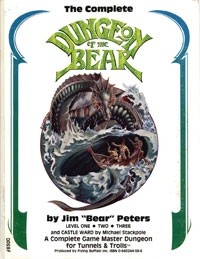 Dungeon of The Bear: GM Led Tunnels & Trolls Gameplay
We want to begin this reassesment of our Tunnels & Trolls 5th Edition review by briefly going over our experiences running Tunnels & Trolls in a more traditional GM moderated game session.
Character Creation:

If you have not had the pleasure of looking over our original review of this product, we suggest you start there–particularly if you find yourself lost in our discussion of the character creation process. As we noted previously, character creation in Tunnels & Trolls 5th Edition is based on rolling 3D6 (three 6 sided dice) for each of a character’s main attributes.
In the case of Tunnels & Trolls 5th Edition these attributes are Strength, Intelligence, Dexterity, Luck, Speed, and Constitution.
Scott, who was running the game, had the players roll for there attributes using this method. The players were then given an option to pick a race other than human for their characters. One player chose to make an Halfling, one player chose to make a Dwarf, and one player chose to remain Human.
As we discussed in the previous article, this led to a wide disparity between character attribute scores. For example, the Dwarven character in the party, thanks to some good rolls, ended up with only one attribute score below 10 (Dexterity) while the Halfling character ended up with a Strength of 4 and two other scores below 10. Starting income was similarly disparate (starting character cash is 3d6 x 10) ranging from 50 Gold Pieces (GP) to 140 GP.
While there was considerable inequality between the characters at the start of play, most of us had positive thoughts regarding character creation. The most important factor for us was time. Creating 3 characters that were ready to “jump in” and play took roughly 30 minutes. Pretty damn impressive considering only the GM and one of the players took part in our intial review and were familiar with Tunnels & Trolls 5th Edition rules.
The ease and speed of Tunnels & Trolls 5th Edition character creation was due in large part to the simplisity of the character creation and the game mechanics. For example, rolling just 3 dice for each character attribute meant that the players did not have to bother with attempting to assign points, or puzzle over which number they should assign to each attribute. In addition, Tunnels & Trolls saving throw system, through which all character “skills” and “abilities” are handled, removed another huge time constraint during character creation. Many modern alternatives to Tunnels & Trolls have detailed skills/abilities systems which require significant investments of time.
Revised Score: B
The critiques which led to our original score of C+ are still present. The method in which character’s are generated in Tunnels & Trolls 5th Edition does result in highly unequal and unbalanced characters. So this game, or at least the 5th Edition rule set, might not be the right choice for many potential players who expect at least some sort of parity amongst different members of a player party.
Having said that, we felt that this actually mattered less in the case of the Tunnels & Trolls GM Adventures than it did in the Tunnels & Trolls Solo Adventures. In the GM Adventures stronger characters were able to account for the failings of the weakest members of the group, while in the Solo Adventures, having a weak character often meant that the character would die during their very first combat encounter.
We also appreciated, and had a lot of fun with, the way the characters turned out. The Halfling member of the party, who had an Intelligence score of 7, played his character like a person with a mild mental handicap. This allowed both the Halfling and the Wizard to come up with a detailed backstory for both of their characters. As it turned out the Halfling was the adopted son of the party’s “dogooder” wizard who had once ran a school for orphaned boys.
This backstory, in tun, forced the person playing the Halfling to roleplay outside of the general archtypes the he would normally play. And having a character’s with a mental handicap led to some pretty awesome, and sometimes funny, roleplaying moments. For example, the Halfling character would often scout ahead for the rest of the party, and relay back information that was inaccurate or that just left out the things the Halfling did not care about. And the childlike tantrum the Halfling threw when the party decided the magic item he had found was not well suited to him was a roleplaying moment all of the players will remember.
It is also important to note here that the free Tunnels & Trolls 5th Edition rule set is abridged. This meant we did not have access to all of the character classes for our GM Adventure playtest. Only Warriors and Wizards are included with this download.
Despite this, Terrible Gamers felt that the character creation process contributed to the overall sense that Tunnels & Trolls was working as Ken St Andre had originally intended. The game is fast to learn and would be very easy for people with little or no experience in tabletop RPGs to pick up. In addition, the character variation was fun for us, though we recognize that most veteran players of tabletop games expect the character creation process in roleplaying games to result in balanced characters.
Combat Pros:
After running through a 3 hour GM led game of Tunnels & Trolls 5th Edition Terrible Gamers came to the conclusion that the game’s combat system works better for GM Adventures than it does for Solo Adventures.
If you recall our original review the combat works by creating a dice pool of D6s (6 sided dice). The number of dice in the pool is determined by the “dice rating” of a characters weapon. A sword with a dice rating of 6 allows the player whose character is wielding it to roll 6D6 during combat. Any bonuses (Tunnels & Trolls calls these bonuses “adds”) that come from a character’s skill at fighting or from their weapons are then added to the total of their dice rolls. The total of a player’s combat dice rolls and bonuses is then compared to that of her opponent. The person with the highest “to hit” total is the winner of that combat round, and the damage dealt is determined by finding the difference between the two “to hit scores.”
In Tunnels & Trolls Solo Adventures, this can sometimes lead to encounters that are impossible for a character to survive before a single die is rolled. As an example, one of the first characters we used in the Goblin Lake Solo Adventure had a maximum possible “to hit” score of 23 and found himself in combat with a creature whose minimum “to hit” score was 31. Since our plucky adventurer had a total of 7 health and the absolute minimum damage he would have to take was 8, we knew he was dead without even rolling.
The Tunnels & Trolls GM Adventures mitigate this somewhat as all of the characters are allowed to roll together when fighting. This means two things:
- All of the characters get to total there “to hit” scores into one attack
- If the group takes damage during combat, that damage can be allocated as the group sees fit
So if a group finds itself fighting a creature that any one of the player characters could not hope to hit alone, that group still has an even shake. This also means that characters with higher constitution scores can absorb more of the incoming damage so that their weaker companions can fight on.
We also found that what was a minor irritation during Solo Adventure play–having to keep track of a multitude of large numbers during combat–was mitigated during the play of the GM Adventures just in virtue of having multiple players. It is far easier for a single person to keep track of the results of her character’s rolls and compare those with the rolls of others than it is for the Solo Adventures player to keep track of everything.
Combat Cons:
While we felt that while the pros of Tunnels & Trolls combat system, at least in the case of the GM Adventures. far outweighed the cons there were a few issues that we encountered:
- The system does not account for individual heroics in combat
- Combat rules as written in the Tunnels & Trolls 5th Edition booklet were sometimes confusing
- Magic items appeared to be broken
What makes the Tunnels & Trolls 5th Edition combat more workable in the GM Adventures than it is in the Solo Adventures is also what robs players of the feeling that their characters are providing individually to combat. In other systems like Dungeons & Dragons 4th Edition, a characters actions during every round of combat are contributing something tangible (if they hit). This could be anything from a special effect on the character they are fighting to a critical hit which splits their advesary in two.
In Tunnels & Trolls the act of combining player attacks (and dice) together during group encounters can really detract from that personal narrative that lets players know they are playing a direct role in a confrontation. This might also be uncomfortable for some GMs who are used to describing combat in great detail. While GMs can still describe combat however they like, its a little more difficult to describe what the dragon is trying to the thief specifically. Which brings up another problem–neither the players nor the GMs can focus their attacks unless the Tunnels & Trolls rules are ignored.
The last two issues we had with Tunnels & Trolls 5th Edition combat during our GM Adventures playtest are related. A number of magic items we encountered during play we did not understand how to use. Either that or they were hopelessly broken.
For example, one of the players retrieved a magical sword that we were told does 5D6 extra damage. At first we were really confused by this, because damage is not calculated until after a hit is determined; However, it should be clear from what we have written earlier, there is no such thing as a damage roll in Tunnels & Trolls (damage is determined by the difference between two “to hit” scores).
Our first attempt to allow the player to use this magic item was a disaster because we let it count towards the group’s total “to hit” score. This meant that in every encounter the player’s magical sword contributed 10D6 dice (5D6 for the weapon itself and 5D6 “extra” for its magical properties) to the group total. With these extra dice, the group couldn’t help but hit and do significant damage during every round of combat.
When we reversed the ruling and only let the player apply the extra 5D6 as damage dice–after the group had scored a “hit”– it was a little, and just a very little, bit better. Every time the players managed to hit, the extra 5D6 damage was obliterating their opponents to the point of making the combat encounters seem trival.
Another example of a magic item that seemed to us entirely broken was one that a character had picked up running Goblin Lake during our playtest of the Tunnels & Trolls Solo Adventures. This item–a ring–doubled every single character attribute score, which in turn meant that the character had a personal bonus of around 53 added to every single combat roll. This again made combat encounters feel trivial.
Revised Score: B
Revised Total Score: B
Despite the issues we may have had with some of the combat our overall impression of using Tunnels & Trolls 5th Edition rules to run the GM Adventures, or to use while running our own group adventures, was very positive. We really enjoyed the fact that game was very easy to learn and that character creation was fast. We also liked how the character creation allowed us to play and develop characters that we would not necessarily think to (or want to) play in other games; However, there were some “flaws” in the combat system, and we do not fully understand if the magic items published for GM Adventures like The Dugeon of the Bear or the Solo Adventures like Goblin Lake are working as intended.
Our final conscensus on the Tunnels & Trolls 5th Edition rules is that, even with its “old school” feel, it is a lot of fun to play. We would highly recomend this game to anyone who was looking to get into tabletop roleplaying, but was intimidated by the more “flashy” and complex games that are out there. Tunnels & Trolls is also pretty much the only tabletop roleplaying game system that not only encourages, but actively supports solo play.
Finally (for real this time), for the tabletop gamers out there who already know and play a multiple RPG systems we think giving Tunnels & Trolls 5th Edition a shot is worth your time. The 5th Edition rules, while not as complete and deep as Tunnels & Trolls 7.5 or the upcoming (October 2013) Deluxe Tunnels & Trolls are free. And even if you wanted to upgrade to more complete rules, or wanted to start buying Tunnels & Trolls modules, the price for entry is not very high.
Plus, we at Terrible Gamers are pretty sure that you can have a lot of fun with this game, like we will in the future. It will be a great back up for days when 3 of our 6 players catch the flu (or flake out on us as they do from time to time)!
(c) Scott Mills 2013