
We have been promising you reviews of Gen Con materials for two weeks now. Well the day is finally here. If you have, you should be tacitly aware of the first game system that we will be reviewing–Tunnels & Trolls.
For those of you who did not read our earlier article (shame on you), Tunnels & Trolls is a fantasy roleplaying game system developed by Ken St Andre and Flying Buffalo, Inc. during the early days the tabletop RPG genre. Just one year after the publishing of the genre creating game, Dungeons & Dragons (1974), Flying Buffalo released Tunnels & Trolls. The intention of Ken and the guys at Flying Buffalo was to create a game that appealed to a broader audience than Dungeons & Dragons.
To really understand why Tunnels & Trolls might have been (and it might still be) a better entrance point for new roleplayers, we have to remember that Dungeons & Dragons originally grew out of the (at the time) very small miniature war gaming community. Tunnels & Trolls was really able to distinguish itself from the war gaming origins of the RPG genre in two ways. First the Tunnels & Trolls system ran on a D6 (6 sided die). This meant that regular people picking up Tunnels & Trolls could use the dice they were most likely to have on hand. There was no need to go out and by the oddly shaped specialty dice used by Dungeons & Dragons (D20, D12, D10, D8, and D4) or to even buy more than one die.
The second, and I think more important, distinguishing characteristic of Tunnels & Trolls was its support of solo play. Even today when we talk about tabletop roleplaying our immediate inclination is that these games are, by their very nature, multiplayer affairs. Indeed nearly every game system out there requires a game master–the chief arbiter and “storyteller”–to function, and the rare exceptions that do not are narrative building games which still require at least two “players.” Tunnels & Trolls is different.
The game itself is designed to accommodate two styles of play: the more traditional GM led adventures and Solo Adventures. The GM adventures are more of your standard roleplaying affair and will be the subject of their own reviews. The Solo Adventures, on the other hand are truly unique in that they occupy a strange position in print media somewhere between very detailed “choose your own adventure” style novels and a game. These are going to be the subject of our review today.
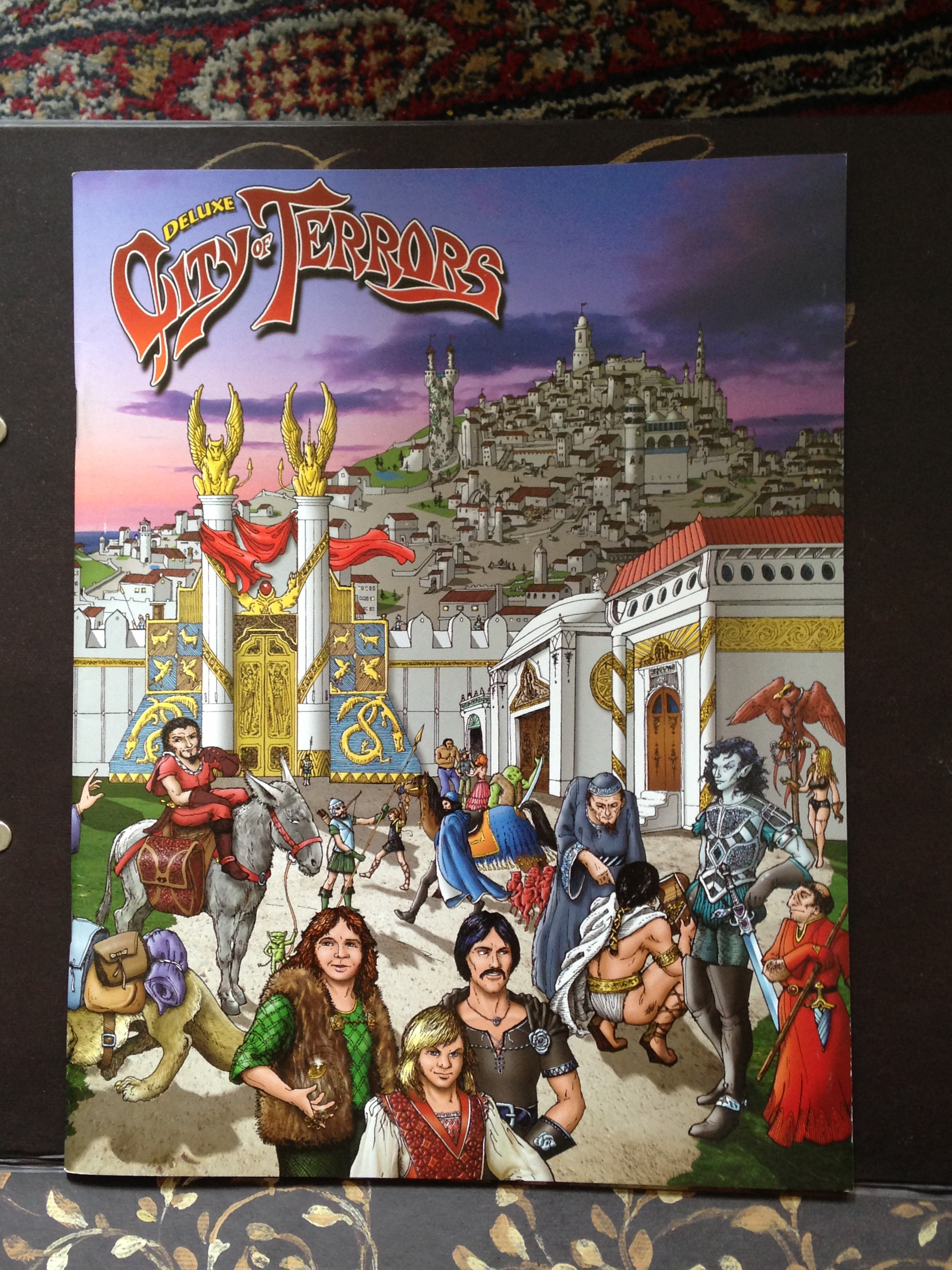 Our original intention was to review Deluxe City of Terrors, a brand new reprint of a classic Tunnels & Trolls Solo Adventure, but do to a minor “miscalculation” on our end, we are not able to do so fully. When we originally picked up Deluxe City of Terrors from the Flying Buffalo booth at Gen Con this year, we thought that the rules to Tunnels & Trolls were published in each adventure. As you can guess, they aren’t. We based this assumption on the childhood memories Scott had of these game modules; However, as Scott discusses quite a bit in his academic work, it turns out that memories are less than trustworthy. So we blame Scott. He should have known better.
Now having said all of that, we were able to find the Tunnels & Trolls game system for free at Drivethrurpg. It actually turns out that there are multiple Tunnels & Trolls rulebooks available for purchase online or soon coming. There is the free truncated version that we used for this play test, the Tunnels & Trolls 7.5 rules, and the much more comprehensive (kickstarter funded) update to the system Deluxe Tunnels & Trolls.
While it is certainly true that we at Terrible Gamers and Rentagamemaster believe that the best review would have at least included the newest rule set, we are very poor (have I mentioned the donate button yet?)… I mean seriously, guys, we cannot even afford the $15 Tunnels & Trolls 7.5 rules and still feed our kids (check out the donate button). Please do not make us donate plasma for games again this month…
In any case, for financial reasons when went with the freely available version of the rules; However, there was a cost to this review. While the free rules do offer everything you need to play the game–the rules were revised in 2007 for free RPG day–they are not “complete.” For example the freely downloaded rules offer only offers you access to two of the four character classes (warrior and wizard) and no explanation of how to go about generating characters of higher levels.
Not being able to have higher level characters is what hampered us the most in writing the review of Deluxe City of Terrors. The opening pages of the module let you know that Deluxe City of Terrors is a book designed for characters of a “middling” level, though first level characters we are told could survive (we think not). Without a reference to the entirety of the level system, we were really unable to determine what level our characters should be. Let us just say that after using the character advancement scheme in the free Tunnels & Trolls rulebook we leveled a warrior to level 6 and were still dying horrible at every encounter.
So instead of just guess (or cheating) we decided that our best bet was to run our characters through the Solo Adventure module that came with the free version of the Tunnels & Trolls rules–Goblin Lake. This was a much better experience for us and afforded us the opportunity to actually get a feel for how Tunnels & Trolls Solo Adventures play.
If you are a Tunnels & Trolls veteran and want to hear what we have to say about the Deluxe City of Terrors module feel free to skip past the next section of the review.
Tunnels & Trolls: Basic Game
What you need:

This is what we used to play Tunnels & Trolls Solo Adventures.
1 Copy of Deluxe City of Terrors
1 Homemade Dice Box
1 Pencil
2 Sheets of Graph Paper
- The free Tunnels & Trolls rules available here (Goblin Lake is included)
- Pencil
- Paper and/or graph paper
- At least 1 six sided die. We used 5 of gamescience D6s (the best dice in the world)
Optional:
- Smartphone or calculator (basic arithmetic)
- Homemade dice rolling box (you can use your table just as well)
Character Creation
Attributes:
The Tunnels & Trolls character creation is straightforward and has a very “old school” feel. Anyone familiar with modern Dungeons & Dragons will recognize most of the player character attributes, which range from Strength (ST) to Speed (SPD) and the individual scores are a reflection of dice rolls and player race.
The dice roll generation is really what gives “rolling” a Tunnels & Trolls character remind us of the first time we played the original Dungeons & Dragons way back in the early 1990s (yes, that is right we are old, or young, we know.) Like in the more venerable versions of Dungeon & Dragons, attribute scores for new Tunnels & Trolls characters are determined by the rolls of just three six sided dice for each stat. In addition to this, while the rules do not specify precisely, it is heavily implied that each stat is rolled separately.
What do we mean by this? In some games like Dungeons & Dragons 4th Edition when a player chooses to (or a their game master tells her to) generate her scores by dice rolls, each roll is made and then the player selects the attributes to which she would like to assign the score. So, still using Dungeons & Dragons 4th Edition as an example, if a player uses the dice roll attribute generation system, among other things, she is allowed to roll their dice 6 separate times–once for attribute. She can then decide which score she wants to assign to each attribute.
Imagine that Sara is making a Dungeons & Dragons character. She needs to generate a score for each of the following 6 attributes: Strength, Constitution, Intelligence, Wisdom, and Charisma.
She rolls 3 D6 (six sided dice) 6 separate times getting the scores of 10, 10, 12, 17, 11, and 9. She would now get to pick which score would go with which attribute.
In Tunnels & Trolls, on the other hand, a player seems to be required to roll for their scores individually. This means that players must roll once for Strength and keep that score, once for Intelligence and keep that score, etc.
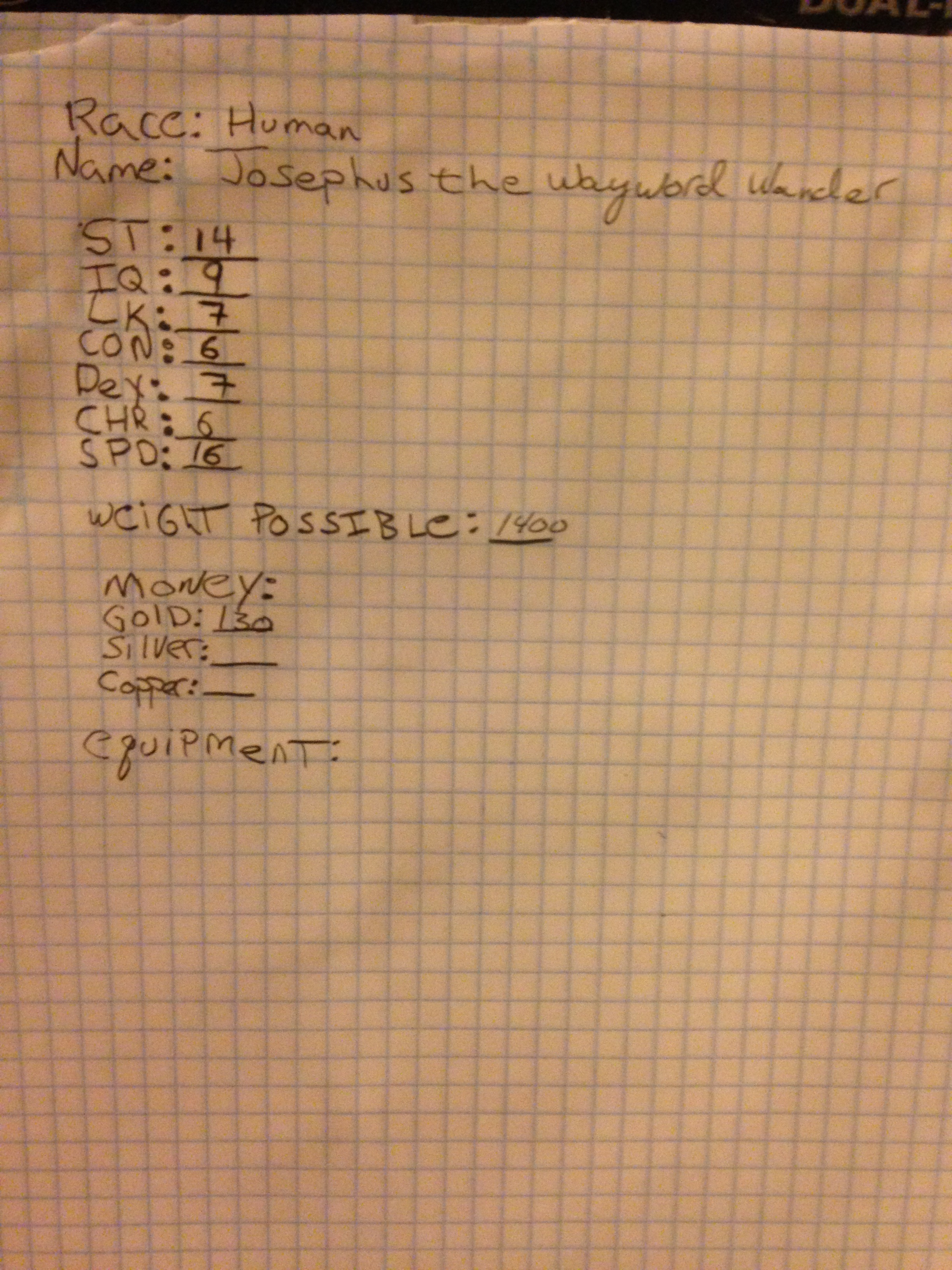
Our first attempt at making a character.
Tunnels & Trolls’ attribute generation system can result in pretty skewed characters, which does not matter as much for Solo Adventuring. The system can still be pretty brutal on a Solo Adventure player though, particularly if they are following the rules to the letter. This is because, as will become more clear when we discuss character classes, each character class (warrior, wizard, rogue or warrior wizard) has certain attribute prerequisites that must be met. As an example, the Tunnels & Trolls rules tell us that making a magic user requires that a character must have an Intelligence score of at least 10 and a Dexterity score of at least 8. If a player wants to make a wizard and happened to roll a 9 for their Intelligence score or a 7 for their Dexterity score, then they are out of luck. They will have to choose a different character class.
Classes:
As we discussed briefly above there are four classes, that we saw, in the Tunnels & Trolls system–Warriors, Wizards, Rogues, and Warrior-Wizards. We only had access to the rules for two: warriors and wizards.
Warriors are your typical fantasy fighters who, while they can still use magic items, cannot use magic “spells.” Their main advantages over playing a spell user are the fact they get to double the effectiveness of their armor and that they can use all the different weapon types.
Wizards are the magic “caster” class in Tunnels & Trolls. While they can only use basic weapons, they gain access to all first level spells (spells of higher level need to be bought with gold). The magic system is essentially a magic point system where each spell has a point cost to use. Unlike other games that have a separate magic point pool, in Tunnels & Trolls you temporarily expend points from your Strength attribute, which regenerates slowly, to cast different spells (hitting zero strength kills you).
Races:
After the players generate their basic attribute scores for their Tunnels & Trolls characters they can then choose their character’s race. Unlike a lot of games Tunnels & Trolls does not confine a player to a set list that she must choose from. Instead they give the “Peters-McAllistor” chart (we have no idea if this is something they made up) on how to modify a Tunnels & Trolls character attribute scores when creating “man-like” races. Included on the chart are some of the more common humanoid “races” taken from fantasy settings: Elves, Dwarves, and Halflings.
The most alien part about Tunnels & Trolls character races are how they modify a character’s attributes. Instead of making a characters Strength, Intelligence, Dexterity, Luck, Charisma, Speed or Constitution go up or down a fixed number–like in Dungeons & Dragons–a character’s race changes by multiplication.
What…!? Fractions!? Noooooooo…
This is not a bad thing really. It is, however, unusual in at a time when many board and tabletop roleplayers are used to more streamlined (read easy to calculate) systems. As an example, we cannot remember the last time we purposefully had to multiply fractions before David, Steve, Adam and Scott tried to make a Elf warriors for Tunnels & Trolls. Getting the attribute scores for an elf player character requires the Tunnels & Trolls player to multiply her Intelligence and Dexterity scores by 3/2 and her Constitution score by 2/3. To put this in perspective making an “elf” in Dungeons & Dragons 4th Edition only involves adding a +2 to the characters Dexterity and Charisma attributes.
Equipment:
Choosing how to equip a Tunnels & Trolls character also reminded us of our early days of roleplaying. Like in many older systems players equip their Tunnels & Trolls characters by purchasing items off a list. What each character can afford varies as starting wealth is also calculated by rolling dice. This means each new character will have somewhere between 30 gold pieces (gp) and 180 (gp) to buy starting gear.
This can make a huge difference given the high costs of important items like weapons and armor. A player starting with only 30 gold might find it impossible to buy anything bigger than a dirk as her starting weapon, let alone be able to afford the available armor.
We were also disappointed with the variety of weapons, armor, and equipment available though we suspect that this had more to do with us using the free version of Tunnels & Trolls than with any flaws in the game.
Grade: C+
While we gave the character creation system in Tunnels & Trolls a C+ it was not a grade that everyone was comfortable with. We lowered the score because of the brutality of random chance, compared to modern “point buy” systems (where every character gets a set amount of points to spend) or modern “roll” systems (rolling 4 dice instead of 3 and keeping the three highest scores), when it came to generating both attribute scores and player starting wealth. For example, we all had the inescapable feeling that Scott’s Dwarven character, which did not have a single core attribute lower than 10, was vastly superior than to David’s human with 4 scores of 7 or lower.
We also lowered the score because having to things like calculate fractions, even if they are simple ones, seems very anachronistic and burdensome when comparing the game to newer systems (nothing exists in a vacuum). The truth is, that this might not be fair given the age of Tunnels & Trolls itself. If we were reviewing the original Dungeons & Dragons here it would like miss the mark in this area as well. What is more, like we discussed in our first article on Tunnels & Trolls making people do fractions might not be a bad thing. Particularly for parents, like the ones that we met at Comic Con, are looking for a game system to play with their kids…. but more on that later.
Yet, in spite of this, we feel that there is a place at the table (pun intended) for roleplaying games whose character creation results in a wider variety of player characters. Having played games like Warhammer Fantasy Roleplay we know that it can be fun to start with a character who is a lowly rat catcher and watch her grow with the game. We also know that forcing players to sometimes play a character can sometimes do great things for a game or a gaming group. It can be funny as hell.
Scott, for instance, remembers a time a member of his group was unlucky enough to roll a Dungeons & Dragons character with a 3 intelligence. Though that player complained at first, his character ended up one of the most fondly remembered by both the player and the group. Come on… rolling a saving throw each time a character tries to speak can only end in hilarity!
It is even responsible, from time to time, for the growth of a player as a person and a roleplayer.
It would also be fair to point out the things we do like about this system. For instance we like that we can generate a character very quickly. Not only are the rules pretty straight forward, but lack of character wealth and a short list of equipment mean that players do not have to puzzle over what type of equipment they might want for their character.
The saving throw mechanic also frees up a lot of character creation time in that Tunnels & Trolls handles skills and abilities by having players make saving throws of differing difficulty against a character’s main attributes. Escaping an Orc raiding party might involve a set of saving throws against Speed while trying to talk the noble in to letting you abscond with his daughter might involve a saving throw against your Charisma. In this way Tunnels & Trolls has elegantly done away with one the largest time sinks during character creation in other games (selecting character skills and abilities) while simultaneously doing away with the need for the complex rules other games need to navigate skill based encounters. In games which has been designed to be simple to learn, and is as fatal to player characters as Tunnels & Trolls seems to be, both are big pluses.
Combat
We have already gone over the saving throw system while talking about character creation, so we are going to jump right into a discussion about the combat. In Tunnels & Trolls combat can be separated into two distinct mechanics–melee (close in) and ranged.
Melee combat works on a system of contested rolls. Each weapon, or monster, is allocated a certain number of dice to roll each round, which are determined by the dice “rating” of the player’s and their opponent weapons or a monsters “monster rating”. For example, if a player is fighting an opponent armed with a short sword, which has a dice rating of 3, and the opponent is armed with a broad sword, which has a dice rating of 5, she would roll 3 D6 for her opponent and 5 D6 for herself. The results of those roles are then modified by personal and weapon bonuses called “adds,” which are added to the point score. The two total scores are then compared, and the person with the highest score “wins” that the round of combat. The damage done in combat is calculated by finding the difference between the two scores.
Though the system is quick and easy to learn, again something that is really helpful to players taking their first dive into tabletop roleplaying, it does have some significant draw backs. The most obvious of these to us was the fact that the combat required us to keep track of a lot of numbers and to do a lot of arithmetic. This really slowed down play for us. Total scores for each side often reached into the 60 and 70s, and we often found the need to spend time writing out the combat “math” just so we wouldn’t lose our place.
We eventually gave up this method of keeping track of the combat in favor of the calculator on our iPhone 5. So anyone picking up Tunnels & Trolls for the first time is advised to pull their calculator out of the junk drawer, or to have their phone at the ready if they want to avoid the hassle of jotting down numbers and working out a multitude of arithmetic problems while playing.
Another complaint we had about the combat system was something we discovered only while running trying to run ourselves through Deluxe City of Terrors and Goblin Lake. It was a somewhat common occurrence for us to find ourselves in fights that were impossible to win. And while this is true of nearly all game systems that have “tiered” difficulty in the way of levels, we were sometimes frustrated that we could not, mathematically, do any damage to some of the creatures we encountered.
In Goblin Lake our first level goblin warrior, with a total possible combat roll of 23 found himself fighting a monster whose minimum dice score in combat was 58. Not only was it impossible for us to hit him, but we did not need to roll a thing to realize that our poor goblin was dead without even needing to make a roll.
We also noticed that this problem cropped up when we were unfortunate enough to be attacked by groups of lower level creatures. This is because Tunnels & Trolls handles single combat against multiple opponents by having all of your opponents combine their dice pool to roll against the player, which created situations where it was not possible to take at least one of the low level baddies screaming to hell with you.
Ranged combat works entirely differently from melee combat in that ranged attacks are resolved by having the attacking player or creature roll a saving throw (the difficulty of that throw is based on the size and range of the target) against their dexterity. The attacker then scores one “hit” against its target for every point above the difficulty of saving throw.
We found the ranged rules to be interesting, since they clearly advantage the person who shoots from a distance. This particular fact sat very well with us because it seemed to capture the reality of being shot at with an arrow far better than most other roleplaying games. We did find it troubling that the cost of ranged weapons during character creation was so high that it was nearly impossible that starting characters would be able to use this to their advantage.
Because we did not have access to the full rules we noted, but did not hold it against Tunnels & Trolls, that there was very little in the way of rules regarding range and movement when we were running the Solo Adventures. Fights were often described as if players just closed in and went right to their melee weapons, and when distances were given we had no idea how to determine when our opponent would have closed the distance to negate our advantage. While playing we just decided that one turn was the extent to which we would use the ranged rules, unless the adventure specifically stated that our opponents were shooting back at us.
Character Advancement:
Character advancement in Tunnels & Trolls will be familiar to those who are experienced players of many tabletop roleplaying games. Different encounters, fights, and adventures award a set amount of experience points (called adventure points in Tunnels & Trolls). When a character accumulate over a certain amount of adventure points that character will level “up.”
The leveling up process involves making changes to the core attributes of a character based on the level that character has just obtained. For example a character who just reached second level has the opportunity to add two points to either Strength or Constitution. This made a lot of sense to us, though for some of the choices you needed to do a bit of quick multiplication or division.
Character advancement was quick, easy and made a clear impact on the skill of our characters.
Something we did wonder about was the amount of points you could assign to the Luck attribute. While all of the other attributes allowed us to assign our level total, or half of our level total, to attribute scores while leveling up, Luck was different. When increasing Luck during the level up process we were allowed to add 4x our new level total to the attribute.
Though we are anything but character “theory crafters” or “min/maxers” at Terrible Gamers and Rentagamemaster it crossed our mind that, given how combat worked and how personal bonuses were parsed–you get 1 add for every point your Strength, Dexterity and Luck scores were over twelve–and given that the vast majority of saving throws we encountered were based on Luck, it might be advantageous to always buy increases to your Luck score and nothing else.
Grade: B
While there were some glaring issues with how combat worked, some of them very frustrating, when assigning our score to Tunnels & Trolls’ combat system we kept in mind what the system was designed to do–be as simple and easily digestible as possible for new players. The combat system as we saw it saw it easily achieved those goals. What is more, we really liked the novelty and the “accuracy” (pun intended) of the ranged combat system, which gives the character shooting at a distance a realistic advantage.
We would have liked to see that advantage more accessible to new players, particularly given that Tunnels & Trolls was designed with them somewhat in mind. What we really did not like was the way in which combat against a much stronger opponent or large group can sometimes be determined without having to roll any dice. Finally, truth be told when compared to modern tabletop roleplaying games, Tunnels & Trolls‘ combat system was a little arduous in the amount of “data” we had to keep track of.
We did not mark the game down much for this though because of the overall simplicity of the system. We also felt that arithmetic, combined with some of the math present during character creation, might make the Tunnels & Trolls rule system an excellent choice for parents and educators looking for games that might help teach a little math. It is certainly the case, which we will discuss in greater detail in the next part of the review, that the Solo Adventure system is an excellent bridge between “choose your own adventure” style fiction and gaming.
Final Score: B-
There are two things to keep in mind when reading our final score. First this score only reflects how we feel about the rule system and character creation presented in the free version of Tunnels & Trolls available on drivethrurpg and not game system in its entirety. There are at two far more complete rulebooks out there, so our thoughts are not necessarily all there is to the story. We have also not yet reviewed the actual Solo Adventure and GM Adventure modules, which would be necessary for us to paint a more complete picture of Tunnels & Trolls.
We also feel that it is important that you read the review entirely. A system like Tunnels & Trolls is replete with things that you might like. In fact, we have been forthright in our review and have pointed out that some of the things we mark the game down for might be just what someone is looking for in a game.
If you don’t have the time, or inclination to read the entire review, we understand and we will try to sum up our findings briefly. Tunnels & Trolls as presented is a simple and easy to learn game system that requires very little investment in time or money. The feel of the character creation calls upon our memories of making characters for older roleplaying games. While simple and fast (it might require some basic math), it can also brutalize player by random chance.
The combat system is, like character creation, simple and easy, but you often have to keep track of a lot of numbers–use a calculator. Combat rewards fighting at a distance or not fighting at all, which we think is good. Our biggest complaint was the very real possibility that players will encounter fights they lose without having to roll a single die.
And perhaps the most important thing which has not been said is that running the Tunnels & Trolls Solo Adventure system is fun. So Tunnels & Trolls wins there on two fronts: it’s a roleplaying game you will probably enjoy AND one of the only systems that has content designed for solo play.
But more on that in the next review!
(c) Scott Mills 2013